Does Homeowners’ Insurance Cover Garage Door Hail Damage?
Key Takeaways
1. Hail is a covered peril on most homeowners’ policies, but that does not guarantee a payout, because your deductible, your policy exclusions, and whether the dents count as cosmetic all affect what you collect.
2. One storm generally means one deductible, not one per damaged item, so filing the door with your roof and gutters gets you past it far faster than filing the door alone.
3. Front Range Raynor has served Northern Colorado since 1987, and a written inspection ahead of the adjuster’s visit puts your door’s real condition on record if the damage later gets called cosmetic.
Which Part of Your Homeowners Policy Pays for a Garage Door?
An attached garage is generally part of your dwelling coverage, and a detached one generally falls under other structures. Hail damage to the door can be covered either way on most standard policies, but the coverage limit behind it differs.
The Insurance Information Institute describes the standard arrangement. A homeowner’s policy pays to repair hail damage to the structure. Detached buildings, such as a garage, are usually covered at roughly 10 percent of the amount insuring the house.
| Your Garage | Policy Section | What That Generally Means for a Hail Claim |
|---|---|---|
| Attached to the house | Dwelling coverage, Coverage A | Draws on the full dwelling limit |
| Detached, separated by clear space | Other structures, Coverage B | Often capped near 10 percent of the dwelling limit, shared with sheds and fences |
| Either one, worn or rusted rather than struck | Generally excluded | Wear and tear is a standard exclusion wherever the door sits |
A carrier that believes your panels were already corroding may treat the dents as pre-existing, so dated photos taken before a storm are worth keeping.
Those are general policy structures rather than Colorado rules. Your declarations page and policy wording govern your claim.
Why a Cosmetic Damage Exclusion Can Sink a Garage Door Claim
Some policies carry a cosmetic damage exclusion, which lets a carrier decline dents that do not affect how something works. A steel garage door is an obvious target, because a dented panel usually still opens and closes.
Look for that endorsement on your declarations page before you file. If it is there, the argument shifts from how the door looks to how it behaves.
Function is what you document. Binding in the track, sitting off balance, a broken weather seal, or an opener under strain can all evidence functional damage rather than purely cosmetic damage. Whether the exclusion applies still turns on the policy wording and on what caused the condition.
How Your Deductible Decides Whether a Garage Door Claim Is Worth Filing
A covered door does not always mean a paid claim. Many Colorado policies now carry a separate wind and hail deductible, set as a percentage of dwelling coverage rather than a flat amount. Reported figures run between one and five percent, though only your declarations page states yours.
That percentage runs against the cost to rebuild your home. It is not the market price, and it is not the value of the door.
| Deductible Type | How It Is Calculated | What It Means After a Hail Storm |
|---|---|---|
| Flat dollar amount | A fixed figure written into the policy | Predictable, and less common than it used to be in Colorado |
| Percentage of dwelling coverage | A share of the rebuild limit, commonly reported at one to five percent | Scales with the home and can far exceed a flat figure |
Hail also drives a big share of what Colorado homeowners pay. A February 2026 Colorado Division of Insurance survey of 20 carriers found that hail accounts for 26 to 54 percent of a homeowner’s premium, depending on the county.
Larimer and Weld were both surveyed. For Front Range and Eastern Plains counties, the Division put hail’s share of the premium at roughly 50 percent, well ahead of wildfire.
So inventory every damaged surface before you call. Under a single covered loss, the deductible generally applies once to the claim rather than to each damaged item. A claim that includes the door, the roof, the gutters, and the window screens reaches that number far faster than the door alone.
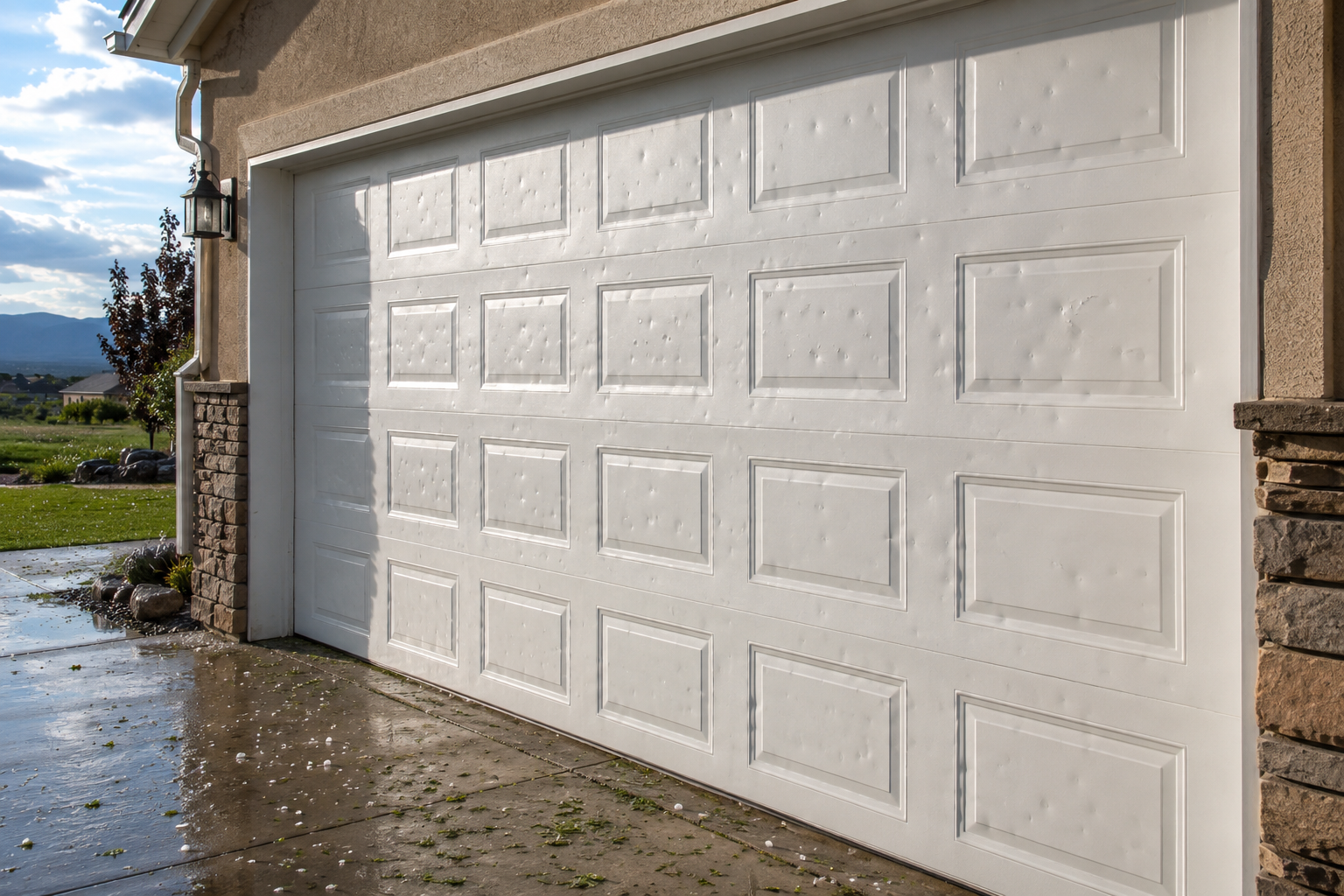
The door also carries evidence. It is usually the largest flat steel surface on a house, and it faces the street. Dents across it help document the size and direction of the storm.
Garage Door Hail Damage in Colorado
Round hail dents and cracked window inserts are a different problem from a bent track or a buckled panel. Only some of that damage stops the door from working.
Thicker 24-gauge steel resists denting better than thinner 28-gauge, though gauge is only one factor. The label inside your door lists the model and its wind rating, which helps confirm exactly which door you have. Front Range Raynor can read it during a hail damage inspection.

Northern Colorado's Trusted Garage Door Pros.
Straightforward pricing, expert installation & repair, serving Fort Collins since 1987.
Get a Free Quote
Why Insurers Pay for One Panel Instead of a Whole Garage Door
Sectional doors are built in stacked panels, so a carrier can approve the two dented sections and leave the rest alone.
The Colorado Division of Insurance addresses this in its hail claim FAQs. No law requires a company to match siding or paint on undamaged areas, and a company is required to repair or replace the actual damage the covered event caused.
Read that narrowly. It means there is no general matching requirement, not that a full door replacement can never be owed.
Here is where the distinction bites on a garage door specifically. If your model, panel profile, or factory color has been discontinued, a replacement section will not match the ones above and below it.
Ask in writing whether your exact section is still manufactured before you accept a partial scope. If it is not available, put that in the claim file. It is an argument for replacing the full door rather than patching it, not a guarantee the carrier will agree.
Replacement Cost and Actual Cash Value on a Garage Door Claim
Approval and payment are two different things, and the settlement basis your policy names decides the gap between them.
With many replacement cost policies, the first payment reflects actual cash value, with some depreciation withheld until covered repairs are completed and documented. The policy sets the conditions and the deadline for recovering that withheld amount. United Policyholders notes that some policies require repairs to be finished within 180 days of the first payment.
Steel doors depreciate. An older door settled on an actual cash value basis can pay well short of what a new one costs. Check which basis your declarations page names for the structure.
When Should You Report Garage Door Hail Damage in Colorado?
Report it as soon as you can. Most policies require notice as soon as practicable after a loss, and that wording sits in your policy rather than in state law.
Filing a lawsuit is a separate deadline. Under C.R.S. 10-4-110.8(12), a homeowners policy issued or renewed after January 1, 2014, cannot require you to sue in less time than the applicable statute of limitations allows.
Some problems take time to show up, like a door that starts binding or straining the opener weeks after the storm. A late report also lets a carrier blame a different storm.
What to Do if Your Insurer Denies a Garage Door Hail Claim
A denial is a position, not a verdict. Start by getting the denial in writing along with the adjuster’s photos. The policy language they cite tells you whether you’re fighting a cosmetic exclusion or a coverage question.
From there, you have several ways to push back:
- Ask for a reinspection with your contractor present. Someone who works on doors can show an adjuster the binding and balance problems a photo won’t capture.
- Invoke the appraisal provision. Most policies have one, where each side picks a representative and those two agree on a neutral third.
- File a complaint with the Colorado Division of Insurance, which reviews whether a carrier followed its own contract.
- Consider a claim for unreasonable delay or denial. C.R.S. 10-3-1116 lets a first-party claimant sue in district court for two times the covered benefit plus reasonable attorney fees and court costs, subject to the statute’s own requirements.
Where to Get a Garage Door Hail Inspection in Northern Colorado
Front Range Raynor Garage Door & Service has worked on doors in Fort Collins, Loveland, Greeley, and Windsor since 1987. Our technicians have seen what Front Range hail does to a steel panel.
We’ll tell you straight whether the damage is cosmetic or affects how the door works. You want that answer before an adjuster writes the scope.
If the claim ends in a new door, thicker steel and added bracing hold up better than a thin single-layer panel. You can operate the options yourself at our Fort Collins showroom.
What You Should Do Next
- Pull your declarations page before you call anyone. Find the wind and hail deductible, check whether the structure settles at replacement cost or actual cash value, and look for a cosmetic damage exclusion.
- Photograph the door and record the model label. Shoot each panel in low-angle light so the dents read, then find the data label inside the door, because the model and color are what decide whether a section can be matched.
- Get the door assessed before the adjuster arrives. Request a free quote or reach the Fort Collins showroom, and we will put the condition of your door in writing.