Garage Door Hail Damage and Wind Protection in Colorado

Key Takeaways
1. Colorado sits in “Hail Alley,” and the Front Range also takes powerful downslope windstorms, so a garage door here faces two very different threats across the year.
2. You cannot stop hail from denting a door, but you can pick heavier-gauge steel, reinforce against wind, and learn to tell cosmetic damage from structural damage.
3. Front Range Raynor has served Northern Colorado since 1987, and our team can inspect storm damage, install a stronger door or help you choose one at our Fort Collins showroom.
Why Is Colorado Weather So Hard on Garage Doors?
Colorado weather is hard on garage doors because the Front Range gets hit from two directions: some of the most frequent large hail in North America during summer, and powerful downslope windstorms through the colder months.
Hail is the first geographical threat. The Front Range sits in the heart of “Hail Alley”, the corridor that records the highest frequency of large hail in North America. The National Weather Service calls hail “severe” once stones reach one inch across, about the size of a quarter, and stones that size fall on Fort Collins, Loveland, and Greeley most summers.
The stones can get big: Colorado’s state-record hailstone, measured near Bethune in August 2019, was 4.83 inches across, and large hail can fall at up to 80 mph. Reports of that size are climbing, with the National Weather Service in Denver logging 13 reports of four-inch hail in 2023, nearly triple the count from 2005.
Wind is the second threat, and it shows up in a different season. From fall through spring, air spilling off the Continental Divide can accelerate into fierce downslope windstorms. Gusts of 80 to 100 mph are not unusual near the foothills, and Fort Collins lands under High Wind Warnings most years.
A garage door here has to shrug off summer hail and stand firm against cold-season wind.
How Colorado’s Climate Affects Your Garage Door
What Does Hail Damage on a Garage Door Look Like?
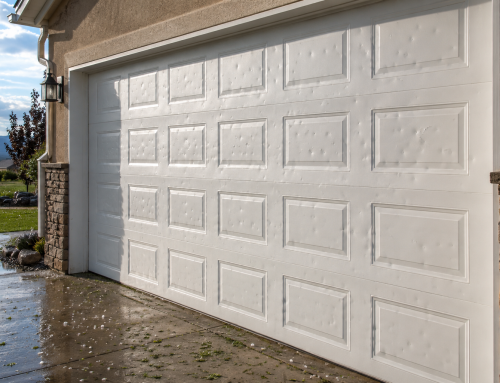
Hail damage on a garage door usually looks like round dents and shallow dimples across the panels, along with chipped or cracked paint and, in a hard storm, cracked window inserts. It tends to show up most on the upper sections.
It is not always obvious from the driveway. Walk up close and look carefully, ideally in low-angle sunlight that throws shadows across the panels.
Common signs include:
- Round dents or shallow dimples across the panels
- Chipped, cracked, or scuffed paint
- Cracked or shattered window inserts
- Dents concentrated near the top of each section
- Dented or bent tracks if stones came in at an angle
The real question is whether the damage is cosmetic or structural. A dent in the flat of a panel usually looks bad, but it does not stop the door from working.
It becomes a problem when it lands on the seams where sections meet, bends a track, or knocks a panel out of shape. That is when a door starts to bind, stick, or run rough.
Damage that reaches the structure changes how the door performs. A bent track or a warped panel makes the opener work harder, which wears the motor, rollers, and springs faster. It can also throw the door off balance and break the weather seal, letting wind and water in.
If you notice new noise or resistance after a storm, the impact likely reached more than the surface. A quick garage door inspection will tell you whether it is skin-deep or structural before the problem spreads.
What Does Wind Damage to a Garage Door Look Like?
Wind damage to a garage door usually shows up as a door that bows or flexes inward during gusts, wavy or buckled panels, rollers popped out of the track, or a door that no longer closes evenly.
Wind damage tends to be more serious than hail damage, because it can compromise how the whole door holds together.
Watch out for:
- A door that bows or flexes inward during gusts
- Panels that look wavy or buckled
- Rollers that have popped out of the track
- A door that sits crooked or will not close evenly
- Rattling, banging, or new gaps around the edges
Federal agencies have long identified the garage door as the largest opening in a home and one of its weakest points in high wind.
When a door fails, wind rushes in and pressurizes the building from the inside. That pressure can push out walls and even lift the roof. Both FEMA and the Insurance Institute for Business & Home Safety treat garage door reinforcement as a core wind-mitigation step.
How Do Garage Door Wind Ratings Work?
A garage door’s wind rating tells you how much wind pressure it can withstand before it fails. It is measured in pounds per square foot of design pressure, not in miles per hour of wind speed, which is where a lot of online advice gets it wrong.
The Door & Access Systems Manufacturers Association sets that standard, and doors are tested under ANSI/DASMA 108.
Every wind-rated door carries a permanent label on the inside listing two numbers: a positive design pressure and a negative design pressure. Positive pressure is wind pushing the door in. Negative pressure is wind trying to suck it out.
Doors are usually tested to 1.5 times their rated pressure to build in a safety margin.
| What the Label Shows | What It Actually Means |
|---|---|
| Design pressure (psf) | The wind load the door is built to resist. It is not a wind speed. |
| Positive (+) rating | Resistance to wind pushing the door inward. |
| Negative (−) rating | Resistance to wind pulling the door outward. |
| ANSI/DASMA 108 | The industry test standard the rating is based on. |
For Colorado, the pressure a door needs depends on your location and exposure, so your local building department has the final say, and foothill homes need more than homes on the plains.
The testing itself happens in the manufacturer’s lab and not at a dealer, but we can read your door’s label and install one that meets your code if it comes up short.
Does Garage Door Weather Stripping Help Against Wind and Rain?
Weather stripping will not stop a hail dent or a wind buckle, but it does keep wind-driven rain, snow, and grit out of your garage, which is the everyday damage most homeowners actually deal with.
A complete seal system includes a bottom seal along the floor, a threshold when the slab needs one, and stop molding with weatherstripping down the sides and across the top. We replace all of these, so you do not have to track down and fit the right parts yourself.
During a windstorm, a worn bottom seal lets in dust and water that can reach stored belongings and drywall. Good seals also cut drafts and help an insulated door hold its temperature.
For comfort and energy loss, an insulated garage door carries more of that load.
If you live in Fort Collins, CO, Front Range Raynor has garage door weatherstripping and other garage door parts. We are a full-service garage door company offering a variety of garage door services, including weatherstripping installation.
How Do You Protect a Garage Door From Hail and Wind?
You cannot fully hail-proof a garage door, but you can limit storm damage by choosing heavier-gauge steel, adding wind reinforcement, keeping the hardware maintained, and documenting the door before a storm hits.
Nothing will stop hail from denting a metal door in a bad storm. Wind resistance is different, and it is something you can build in and maintain.
Here is where your effort actually pays off:
- Choose the right door when you replace. Heavier 24- or 25-gauge steel resists dents far better than thin 27- or 28-gauge skins.
- Add wind reinforcement. Horizontal struts and reinforced brackets stiffen the door and help it stay in its tracks under pressure.
- Keep hardware tight. Check hinges, brackets, and track bolts, since wind exploits anything loose.
- Lubricate the moving parts so the door stays balanced and does not strain.
- Inspect on a schedule. Look the door over before summer hail season, then again before the windy months.
- Photograph the door while it is in good shape. Dated photos make an insurance claim far easier if hail hits later.
| Material | Hail Performance | Wind Performance | Notes |
|---|---|---|---|
| Heavy-gauge steel (24–25 ga) | Best dent resistance of the common options | Strong once reinforced | The popular pick along the Front Range |
| Thin-gauge steel (27–28 ga) | Dents easily | Adequate if braced | Lower cost, more storm repairs over time |
| Aluminum | Dents readily | Light, needs reinforcement | Rust-resistant but softer metal |
| Wood | Can crack or gouge | Heavy and solid | More upkeep in dry Colorado air |
Heavy-gauge steel and reinforcement add upfront cost. In a hail-and-wind climate, that cost usually comes back in the form of fewer repairs and a door that survives the next big storm.
You can handle a lot of this yourself. If you would rather not, our team can install a garage door according to your needs, take care of the reinforcement and hardware, and run a seasonal inspection alongside providing a free quotation.
When Should You Call a Professional for Garage Door Damage?
Call a professional when the door is off its tracks, a panel is buckled, a track is bent, or you suspect the springs or cables were affected, because those are safety issues rather than quick fixes.
Call a professional when:
- The door is off its tracks or will not open and close
- A panel is buckled or a track is bent
- You suspect the springs or cables were affected. These are under high tension and are dangerous to touch.
- You need the damage documented for an insurance claim
- You are weighing repair against replacement after a major hit
We, at Front Range Raynor, will tell you honestly whether a door needs a single panel, a reinforcement kit, or a full replacement.

Who Should You Call for Garage Door Storm Damage in Northern Colorado?
Front Range Raynor Garage Door & Service has worked on garage doors across Northern Colorado since 1987, so a Front Range storm is nothing new to us. We are locally owned in Fort Collins, and as a factory-authorized dealer, our technicians install and service doors from the major brands.
If you want to compare your options before you commit, you are welcome to stop by our Fort Collins showroom and check out a few doors. We quote everything up front, so there are no surprises later.
When a storm does hit, we can take it from there, whether that is a repair, a new door and installation, or just the parts to set things right.
What You Should Do Next
- Inspect your door up close after the next storm, and photograph anything you find.
- Check the inside of the door for a wind-rating label, so you know what you are working with.
- Contact Front Range Raynor for a straightforward assessment and honest options, whether that is a repair, a reinforcement kit, or a new door built for Colorado weather.