Effects of Road Salt on Garage Doors in Colorado
Key Takeaways
1. Road salt corrodes a garage door from the bottom up, attacking the lowest section, the bottom seal retainer, and the hardware within about two feet of the floor long before anything shows on the upper panels.
2. Most of that corrosion happens inside your closed garage, where salty meltwater drips off the car and keeps chloride residue chemically active after the driveway already looks dry.
3. Front Range Raynor has served Northern Colorado homeowners since 1987, and our technicians can inspect salt corrosion while it is still a paint problem instead of a steel problem.
What Does Road Salt Do to a Garage Door?
Road salt dissolves into a chloride solution that eats through the paint and zinc coating protecting your door’s steel, then pits the bare metal underneath. The effects of road salt on garage doors almost always appear first at the bottom section and the hardware closest to the floor.
Salt does not create rust. Steel rusts when water and oxygen reach it, and chloride ions make that reaction move much faster by turning any damp film into a conductive electrolyte.
A drop of salty water on bare steel behaves like a tiny battery, which is why a scratch that would have stayed cosmetic for years can start bubbling in a single winter.
How Is Colorado Deicer Different From Plain Rock Salt?
What reaches your driveway in Northern Colorado is rarely straight rock salt. CDOT treats highways with liquid magnesium chloride and with Ice Slicer, a mined salt that is mostly sodium chloride with small amounts of magnesium and other chlorides.
Fort Collins also pretreats streets with salt brine ahead of storms so snow cannot bond to the pavement. Your tires pick up that blend and carry it home.
That blend matters more than most homeowners realize. Research led by Yunping Xi at the University of Colorado Boulder, conducted for CDOT, tested both salts against common vehicle metals and found that the ranking flips with humidity.
Magnesium chloride caused more damage in humid conditions, and sodium chloride caused more damage in arid conditions or when the metal was fully immersed. The reason is physical. Magnesium chloride is thicker and pulls water from the air far more aggressively, so it crystallizes onto metal as the surface dries, then returns to liquid the moment humidity rises again.
| Deicer on Your Driveway | Where It Comes From | Why It Matters for a Garage Door |
|---|---|---|
| Liquid magnesium chloride | CDOT highway anti-icing and deicing | Clings to metal and reactivates whenever humidity rises |
| Ice Slicer (salt plus magnesium chloride) | CDOT solid deicer | Delivers both chlorides at once, harsher than either alone |
| Salt brine | Fort Collins street pretreatment | Dries to a fine residue that is easy to miss until rust appears |
| Bagged sidewalk ice melt | Your own steps and driveway apron | Applied closest to the door and often tracked directly under it |
A separate study of truck components, summarized in a research synthesis for the Idaho Transportation Department, found that a mixture of magnesium chloride and sodium chloride was more corrosive than either chloride by itself. On the Front Range, you are usually dealing with a mixture.
Colorado deicers carry corrosion inhibitors, and agencies say so. Still, that same synthesis found that inhibitors meeting the 70 percent corrosion reduction target in the laboratory frequently failed to hit it in field trials. Treat the inhibitor as a help, not as permission to skip cleaning.
Why Your Closed Garage Is the Worst Place for Salt Residue
Dry air slows magnesium chloride down outdoors. Your garage undoes that. Low humidity keeps the residue crystallized instead of working, which is part of why drivers arriving from the Midwest notice that Front Range vehicles carry less rust. That protection is narrower than it looks, though, because the same research found rock salt does more damage in arid conditions, and Colorado roads carry both.
The air inside your garage is not outdoor air. Park a snow-covered car inside a closed, largely unventilated box and that snow becomes humidity and a puddle of salty water on the slab. The bottom section of your door, the seal, and the lowest few inches of track sit directly in it.
That wet-dry cycle is exactly what the CDOT research tied to magnesium chloride’s damage. And the puddle itself is the immersion condition where plain salt does its worst.
The pooling makes it worse. Many garage slabs have a low spot or dip right under the door, where water collects instead of draining. Homeowners describe rust climbing the door and the vertical tracks an inch or two up from the concrete, which is a drainage problem wearing a corrosion coat.
Which Garage Door Parts Rust First From Road Salt?
Salt damage concentrates in the lowest two feet of the door system. Within that zone, it is worse anywhere two pieces of metal meet, because salt solution wicks into the gap and then cannot dry out or be rinsed away.
A national corrosion study of galvanized highway hardware found the greatest metal loss in crevices and beneath fasteners, while boldly exposed surfaces often showed no measurable loss. A garage door is full of those crevices.
| Component | Why Salt Reaches It | What to Look For |
|---|---|---|
| Bottom section | Roll-formed bends with thin paint sit in standing meltwater | Paint bubbling, orange streaks, soft or flaking metal along the lower lip |
| Bottom seal retainer | The channel traps salty water against the door and cannot self-drain | Rust inside the channel, a seal that will not stay seated |
| Bottom brackets and cable ends | Bolted crevices hold the solution long after the floor dries | Rust bleeding from fastener heads, frayed cable strands |
| Vertical track and low rollers | Track feet bolt to the jamb at floor level | Rust rising an inch or two from the concrete, rough or noisy travel |
Torsion springs are the exception to the two-foot rule. They sit on a shaft above the opening, well clear of the puddle, but the damp chloride-heavy air of a closed winter garage still reaches them, and there the failure is not cosmetic.
DASMA’s technical data sheet on spring cycle life warns that rust reduces the effective area of spring wire, and that corrosion pits become starting points for fatigue cracks that shorten cycle life. A spring that looked fine in October can let go on the first hard January morning.
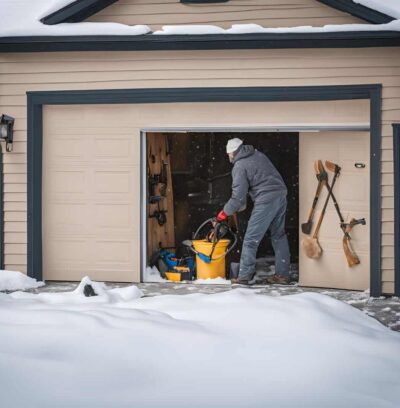
Preparing Your Garage for Winter: Essential Tips
How to Protect a Garage Door From Road Salt
None of this requires special equipment. It just takes a few small habits to add to your schedule, rather than waiting for spring.
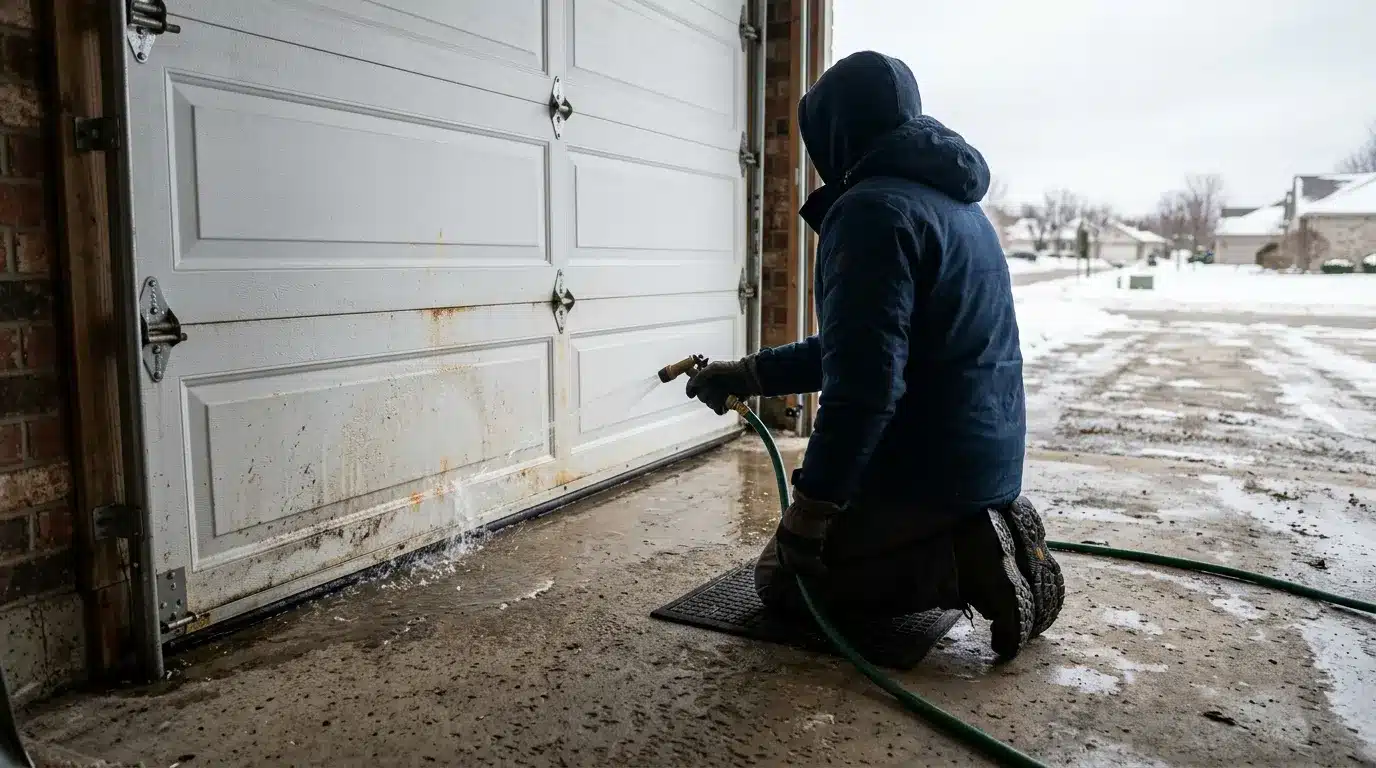
- Rinse the bottom two feet of the door with plain water after storm weeks, because dissolving and carrying the chloride away is the entire objective. A garden hose or a bucket and a sponge is enough.
- Squeegee the slab dry after you park a wet vehicle, which removes the standing water that keeps the door’s lower edge in contact with salt for hours.
- Fix the low spot if water consistently pools under the closed door, because no seal or coating can withstand a puddle that never leaves.
- Touch up chips and scratches on the lower sections before winter, because an intact coating is the only thing standing between chloride and bare steel.
- Use a silicone lubricant on rollers, hinges, and springs rather than heavy grease, as grease traps grit and salt against the metal instead of shedding them.
- Replace a failed bottom seal promptly, and add a threshold if your driveway pitches toward the opening, so meltwater stops migrating under the door.
- Inspect twice, once before the first storm and once at the spring thaw, which is when new corrosion is easiest to catch and cheapest to stop. You can check out our winter garage preparation checklist to make sure your bases are completely covered.
Worn hinges and rollers accelerate everything above, because a door that drags scrapes its own coating off. Front Range Raynor stocks replacement parts for these repairs.
Do Some Garage Door Materials Resist Road Salt Better Than Others?
Yes, though the practical differences are smaller than marketing suggests, and coating thickness matters more than the headline material.
| Material | Salt Corrosion Resistance | Practical Trade-Off |
|---|---|---|
| Heavier-gauge galvanized steel with a baked finish | Good, and the zinc layer keeps protecting through minor scratches | Still rusts once the coating is breached at a bend or crevice |
| Thin-gauge steel | Weakest of the common choices, since less zinc means less time before bare steel is exposed | Lower upfront cost, more corrosion repairs later |
| Aluminum | Strong, because it forms a stable oxide layer instead of flaking rust | Softer metal that dents more easily in hail country |
| Composite and fiberglass overlays | Very good, since the exposed surface is not steel | Substructure hardware is still steel and still needs rinsing |
The thickness point matters more than the material name. In the same galvanized hardware testing, the thinner zinc coating pitted roughly an order of magnitude deeper than the thicker one under identical exposure. Buying a heavier, better-coated door is as much a corrosion decision as a dent-resistance decision, and it is the kind of comparison our Fort Collins showroom exists for.
Get Road Salt Damage Checked by Front Range Raynor
Front Range Raynor Garage Door & Service has worked on Northern Colorado doors since 1987, through more than three decades of magnesium chloride winters. Our factory-trained technicians know the difference between surface rust you can sand and repaint and pitting that has already compromised a bottom section or a spring.
We are a solutions company before we are a sales company, which in practice means we will tell you when a seal, a bracket, and a rinse routine solve the problem. When corrosion has gone further, a single section can often be replaced rather than the whole door. If a new door is the answer, our quoted price includes removal, installation, and taxes with nothing added at the end.
What You Should Do Next
- Look at the bottom two feet with the door closed, in low-angle light, and check the seal retainer channel, the track feet, and the panel face.
- Rinse and dry that zone this week, then squeegee the slab, and watch whether water pools under the door the next time you park a wet car.
- Contact Front Range Raynor for an inspection if you find bubbling paint, rusted hardware, or a door that feels heavier than it did, or request a quote if a section has already rusted through.
FAQs