10 Garage Door Safety Rules to Teach Your Kids

Key Takeaways
1. Garage doors cause 20,000 to 30,000 injuries each year in the United States, with children making up a significant portion of those incidents.
2. The 10 most important garage door safety rules cover remote control access, the no-play zone, waiting for the door to fully close, and never trying to beat a closing door.
3. Front Range Raynor Garage Door & Service provides certified safety inspections and modern opener upgrades for Fort Collins families.
Why Garage Door Safety for Kids Matters
The garage door is the largest moving object in your home. A standard residential door weighs between 130 and 400 pounds, and the opener can exert hundreds of pounds of force. To an adult, it is a daily convenience. To a small child, it can be a serious hazard.
According to the U.S. Consumer Product Safety Commission (CPSC), garage doors are responsible for 20,000 to 30,000 injuries each year in the United States. A significant share involves children, often from preventable scenarios: kids trying to dart under a closing door, fingers caught between panels, or children operating remotes without supervision.
Garage Door Safety Rules to Teach Your Kids
The good news is that almost all of these accidents are preventable. With a few clear rules, regular safety testing, and a working modern opener, families can use their garage door every day without incident.
1. The Garage Door Is Not a Toy
This is the foundation of every other rule. Kids need to understand that the garage door is a powerful machine, not something to play with.
Explain it in age-appropriate terms. For younger children, “the garage door is very heavy and could hurt you” is enough. For older kids, the weight and force facts make the point. Adults who run under a closing door teach their kids it is acceptable, so model the rule yourself.
2. Keep Hands and Fingers Away from Panel Joints
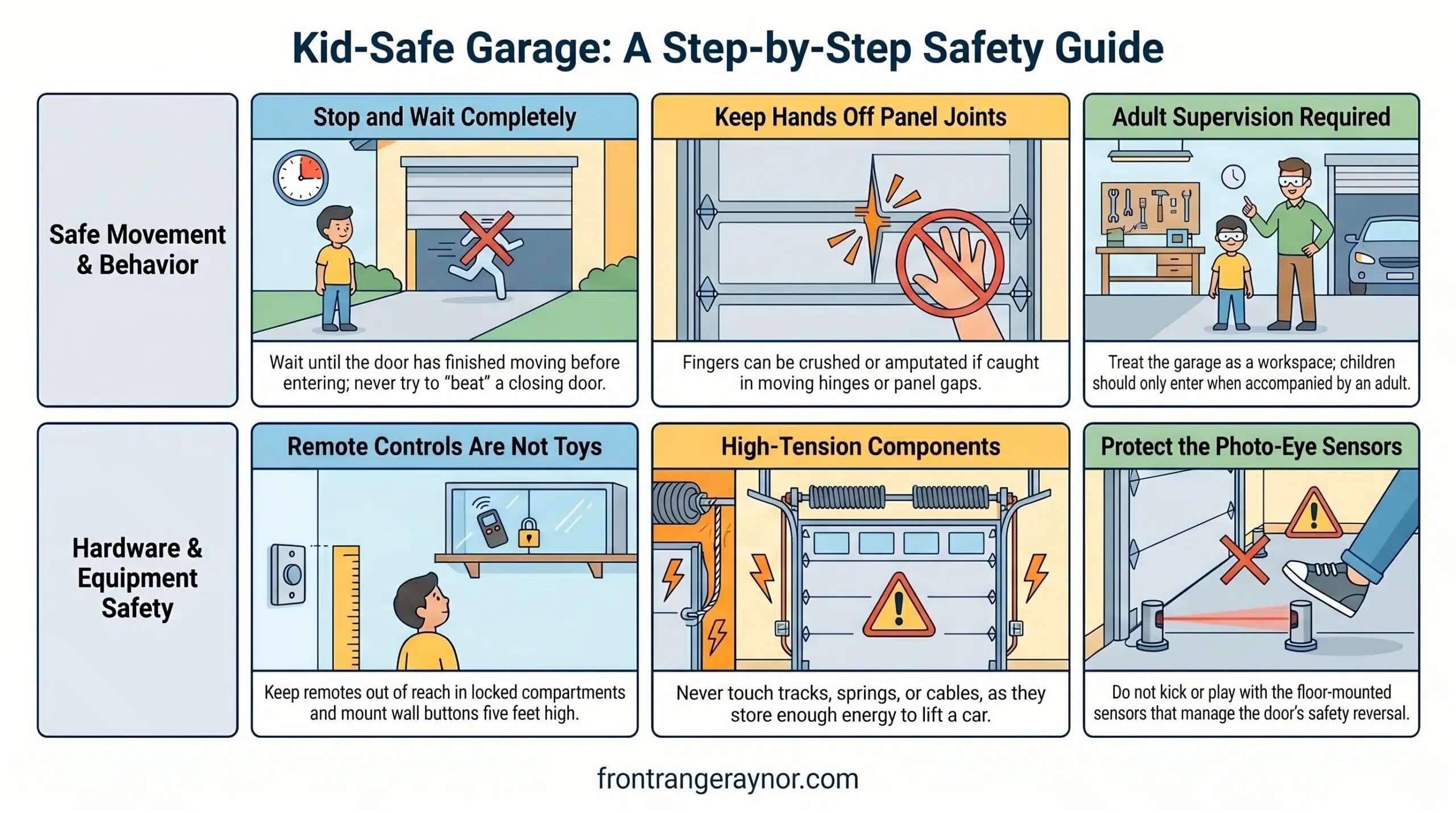
Section garage doors have hinges between each panel. As the door moves, those joints pinch closed. Fingers caught in a closing hinge can be crushed or amputated.
Teach kids to keep their hands completely away from the door while it is moving. Modern doors with pinch-resistant panel designs reduce the risk, but kids should still be trained to keep hands away.
3. Never Try to Beat a Closing Door
The “garage door game,” where kids try to run under a closing door before it shuts, has been fatal. CPSC records track multiple child deaths from this exact scenario, often involving children between 2 and 14 years old.
This rule needs to be absolute. No running under a closing door. No rolling under. No reaching back as the door descends. If the door is moving, the kids are on the outside or the inside, never crossing under.
4. Wait Until the Door Stops Moving
Kids should learn to wait until the door has completely opened or closed before walking through. The opener’s safety features rely on the door being in a known state. A moving door can still reverse direction or behave erratically if something is wrong.
This rule applies to adults, too. Modeling the behavior is the best teaching tool.
5. Remote Controls Are Not Toys
Remote controls look like toys to small kids. They are not. CPSC has tracked multiple deaths caused by children pressing remote buttons while standing under the door.
The rule for kids: do not touch the remote. The rule for parents: keep remotes out of children’s reach. Store them in:
- The glove compartment of the car (locked when parked outside)
- Center consoles
- A locked drawer inside the house
- On adult keychains
The wall-mounted control button inside the garage should be installed at least 5 feet off the floor, above the reach of small children.
6. Stay Out of the Garage Without an Adult
The garage is a workspace, not a play area. Tools, chemicals, vehicles, and the door itself all create hazards for unsupervised kids.
Make the garage an adult-supervised zone. If kids need to retrieve something, they ask first. This prevents the most dangerous scenarios where children play unsupervised near the moving parts.
7. Never Touch the Tracks, Springs, or Cables
The mechanical components of a garage door are under significant tension. Torsion springs above the door store enough energy to lift the equivalent of a small car. Lifting cables run from the springs to the bottom of the door under constant load.
If a spring or cable fails while a child is touching it, the result can be severe injury. Teach kids that these parts are off-limits.
The International Door Association reminds parents that “garage door openers are not toys” and that children should be taught not to play near the door system.
8. Tell an Adult if Something Looks or Sounds Wrong
Kids often notice problems before adults do. They hear the unusual noises, see the slow operation, or watch the door reverse for no reason.
Teach your children to report anything unusual: grinding noises, jerky movement, gaps in the springs, frayed cables, or a door that does not open and close smoothly. Make it clear they will not get in trouble for speaking up. Children who feel comfortable reporting issues become an early warning system for problems before they cause harm.
9. The Photo-Eye Sensors Are Not Targets
Photo-eye sensors mounted about 6 inches off the floor on either side of the door create an invisible beam that stops the door if broken during closing. Kids sometimes treat them like toys, waving their hands through the beam or kicking the brackets.
The sensors are precise instruments. Bumping them out of alignment, getting them dirty, or pulling on the wires can disable the safety system entirely. Kids should know what the sensors do and leave them alone.
10. Stop and Wait When Pets Are Near the Door
Kids often want to follow a pet running into or out of the garage, especially when a door is closing. The combination of a moving pet, a moving child, and a moving door creates real risk.
Teach kids that when the door is moving, they stop and wait. The pet can be retrieved once the door has stopped. The few seconds saved by rushing are not worth it.
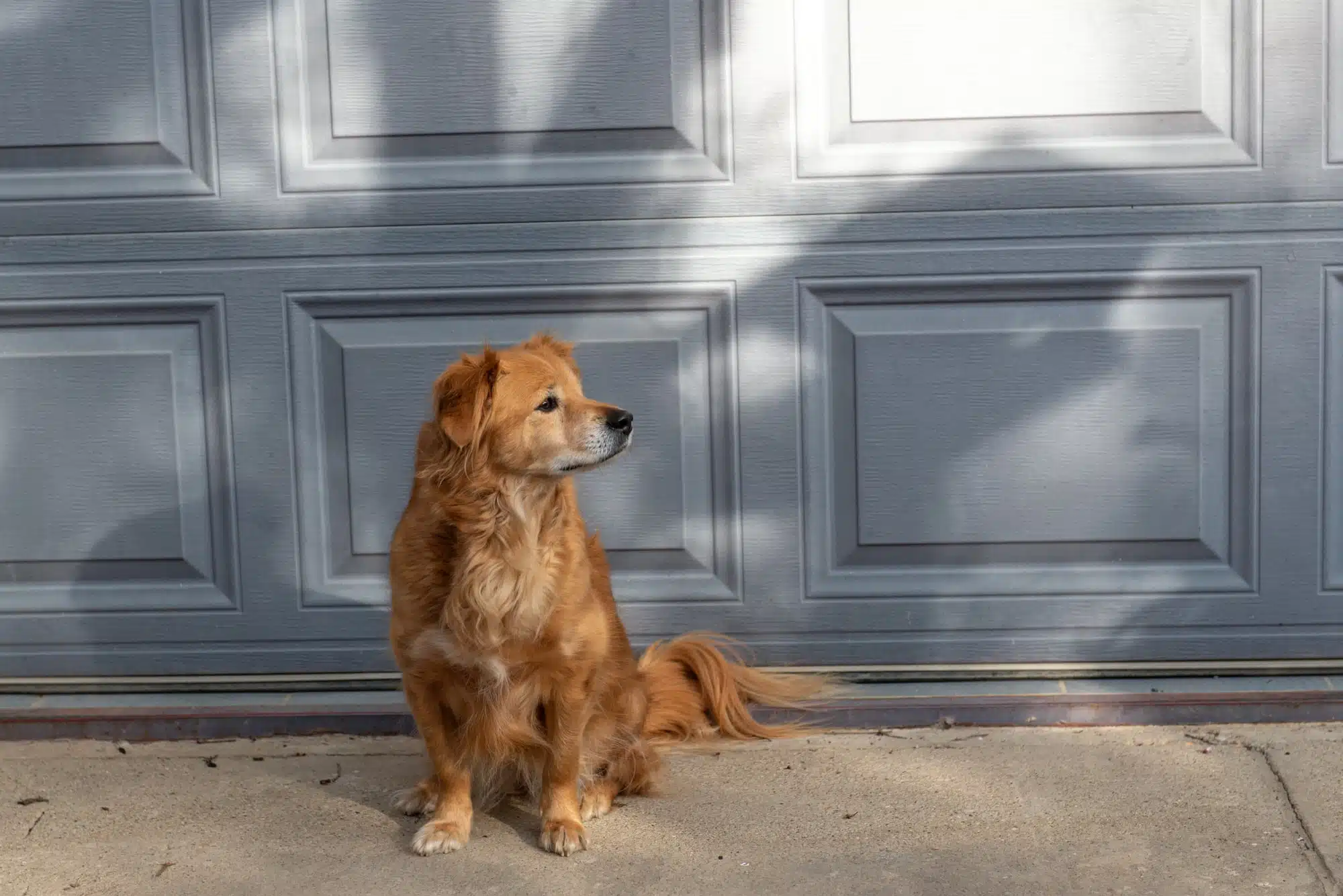
If You Have Pets, Your Garage Door Needs These Safety Features
How Often to Practice These Garage Door Safety Rules
Talking about these rules once is not enough. Kids forget. Make garage door safety part of your annual home safety conversation, alongside fire drills and water safety.
Times to revisit the rules:
- When kids reach the age where they want more independence (typically 5 to 8)
- After any move to a new home
- When the garage door or opener is replaced
- After any safety incident, even a near miss
- At the start of summer, when kids are home more
A 10-minute conversation once or twice a year keeps the rules fresh.
What Parents Should Do Beyond Teaching Kids Safety Garage Door Rules
Rules for kids are only half the equation. Parents have responsibilities too.
- Test the auto-reverse mechanism monthly. Place a 2×4 board on the floor and close the door. It should reverse within 2 seconds of contact. If it does not, stop using the automatic opener and call a professional.
- Test the photo-eye sensors monthly. Wave a broom handle through the beam while the door is closing. It should stop and reverse immediately.
- Replace openers manufactured before 1993. Pre-1993 units lack the required entrapment protection and are responsible for a disproportionate share of child injuries.
- Schedule annual professional inspections. Certified technicians catch issues that monthly homeowner tests cannot, including spring fatigue, cable wear, and force calibration drift.
- Install controls out of reach. Wall buttons should be at least 5 feet off the ground. Remotes should never be left where children can grab them.

How Front Range Raynor Helps Fort Collins Families Stay Safe
Teaching kids the rules is the foundation of garage door safety. Making sure the door itself is safe to operate around children requires professional support.
Front Range Raynor Garage Door & Service has helped Fort Collins families keep their garages safe since 1987. As a Raynor Door Authority company, we provide:
- Professional safety inspections that test every component your monthly check cannot reach
- Opener replacements for pre-1993 units that lack modern entrapment protection
- Sensor recalibration and repair for failed photo-eye systems
- 24/7 emergency service for urgent safety failures
- Premium Raynor doors and openers with the latest safety features
If your garage door has not been professionally inspected in the past year, or if your opener is more than 15 years old, schedule an evaluation. The cost is small. The peace of mind is significant.
What You Should Do Next
Garage door safety for kids comes down to clear rules, regular testing, and a properly maintained door system.
- Have the safety conversation with your kids this week. Walk through the 10 rules in age-appropriate language.
- Test your auto-reverse and photo-eye sensors today. Both tests take less than 5 minutes combined.
- Contact Front Range Raynor if any test fails or if it has been more than a year since a professional inspection. Call 970-223-9555 or visit our showroom at 3847 South Mason St in Fort Collins, CO 80525.