Best Garage Door Security System Upgrades You Need ASAP
Key Takeaways
1. Effective garage door security is layered, combining a strong door and locking hardware with modern opener controls and managed credentials.
2. Forced entry and reused access are the biggest real-world risks, making physical locking, rolling-code remotes, and credential cleanup critical upgrades.
3. Front Range Raynor can assess, recommend, and install the right upgrades end-to-end. Our solutions-first approach and transparent pricing help service organizations secure doors.
What Is a Garage Door Security System?
A garage door security system combines door hardware, opener controls, credential management (remotes, PINs, mobile access), and monitoring or alerts to help prevent unauthorized entry and improve operational accountability.
In practice, it works like a chain. If one link is weak, the overall system feels “secure” right up until it is tested by an opportunistic intrusion, a lost remote, a rushed end-of-day close, or a simple maintenance issue that leaves the door operating outside its intended range.
Key Components of a Garage Door Security System
A garage door security system has five layers: the door itself, locking mechanisms, the opener, credential management, and safety features. Each layer handles a different job, and gaps in any one layer create vulnerabilities that the others can’t cover.
The Door
The door provides physical resistance to forced entry. A sturdy door with properly fitted tracks and well-maintained rollers resists prying, lifting, and impact.
If the door can be forced out of alignment or pulled from its tracks, nothing downstream can compensate. The door is the foundation – everything else builds on it.
Locking Mechanisms
Locks prevent manual lift attacks – someone grabbing the bottom of a closed door and pulling it up. Some setups use manual slide locks. Others rely on opener-integrated resistance or automatic deadbolts that engage when the door closes.
Once that lock engages, brute-force lifting becomes far less realistic.
The Opener
The opener verifies commands before allowing movement. It accepts a signal, checks whether that signal is authorized, and only then moves the door.
Modern openers use rolling code technology, generating a new code with each use. This prevents replay attacks, where someone captures a signal and reuses it to gain access.
Credential Management
Credential management controls and tracks who can open the door. This layer answers three questions: Who has access? How do they gain it? And is there a record?
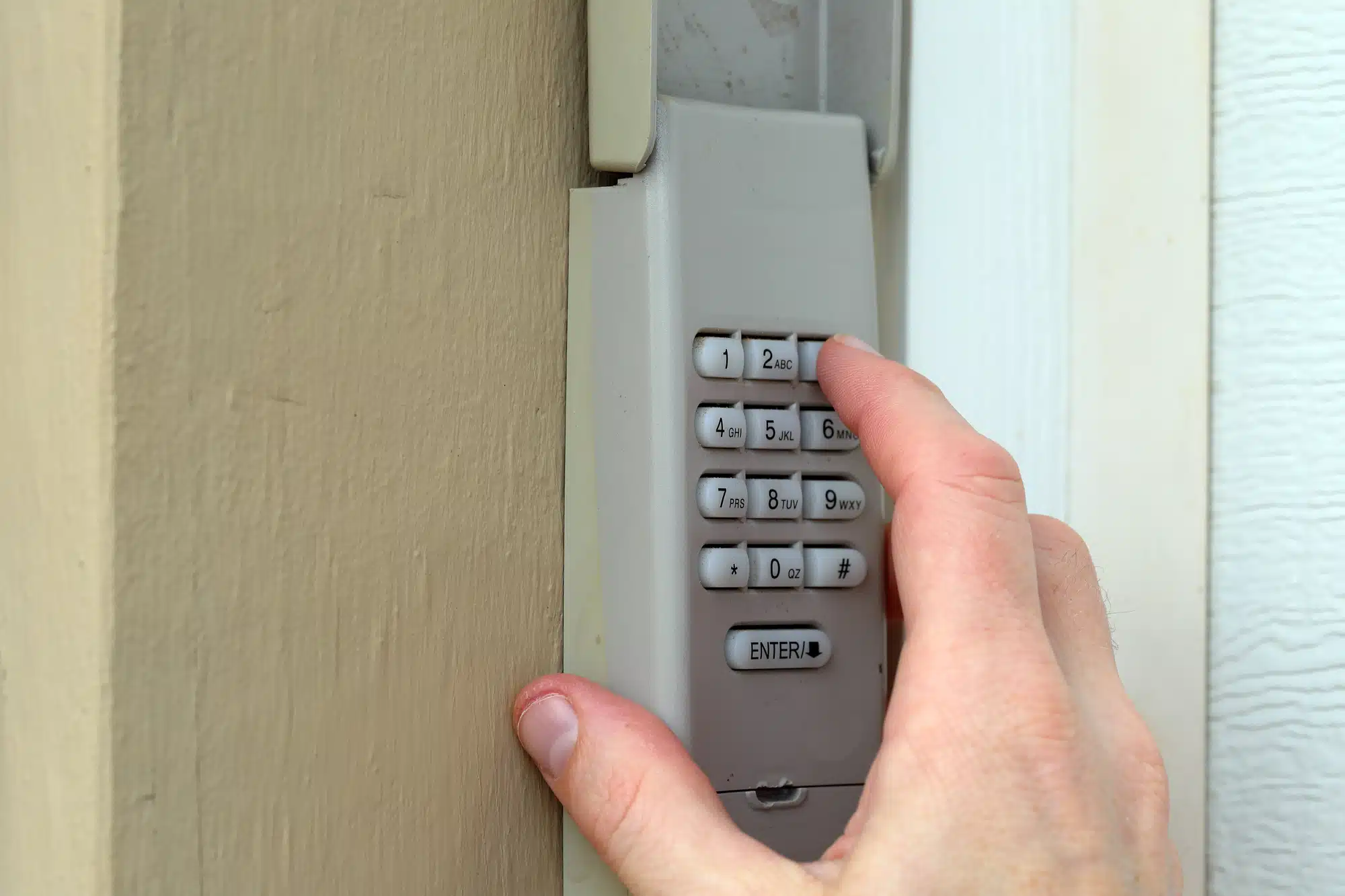
Remotes can be assigned and revoked. Keypads can use PINs that change when employees leave. Mobile access platforms may offer activity logs and alerts.
For commercial operations, this accountability often matters as much as intrusion prevention. It answers everyday questions: Was the door left open? Who accessed the bay after hours?
Safety Features
Safety features maintain system reliability over time. A door that fails to reverse, closes unsafely, or has misaligned photo eyes isn’t just a liability – it’s unreliable. Unreliable systems invite workarounds: propped doors, disabled sensors, bypass habits.
Since 1993, U.S.-manufactured openers have included secondary safety-reversing features like photoelectric eyes. UL 325 sets the entrapment protection standard most manufacturers follow.
Quick and Effective Risk Assessment for Your Garage Door Security System (10 Minutes)
This is a fast, practical check that focuses on the failure points that most often show up in real facilities: credentials that are easy to reuse, limited visibility into who accessed the bay, and doors that are secure on paper but vulnerable in the field.
A useful context point: the FBI reports that 55.7% of burglaries involved forcible entry in 2019, and victims suffered an estimated $3.0 billion in property losses that year (average loss $2,661 per burglary offense).
Even though those figures are not garage-specific, they reinforce why resistance and physical locking are worth checking first.
1) “Can anyone reuse a remote code?” (Fixed code vs. rolling code)
Check whether access is protected by modern rolling-code credentials or older fixed-code behavior that can be repeated.
What to note in 60 seconds:
- Does your opener/access ecosystem explicitly support rolling-code style behavior (often described in manufacturer security features)?
- Do you have a written process to remove a lost remote from the system?
2) “Do we know who opened the door and when?” (Activity logs and assigned credentials)
Check whether you can answer basic accountability questions without guesswork. In service operations, “security” is often operational. A door left open can expose inventory, tools, and vehicles. Logs and alerts help you respond quickly.
What to note in 90 seconds:
- Do you have event history (open/close records) that is actually used?
- Are credentials assigned to people or roles, rather than “shared by the team”?
3) “Can the door be forced up?” (Reinforcement, locks, operator resistance)
Check whether the barrier is physically resistant, not only “electronically controlled.” A garage door is a significant moving barrier. If the door, track, and locking approach are weak, a strong opener alone is not a complete security plan.
The FBI’s forcible-entry share is a reminder to treat forced entry as a common scenario, not a rare edge case. Federal Bureau of Investigation
What to note in 2 minutes:
- Is there a physical locking method that reliably engages at close (manual or automatic), and is it compatible with how your team actually operates?
- Are the tracks and door sections stable and properly aligned, without obvious looseness?
4) “Will the door close safely during unattended operation?”
Check whether safety systems are present, correctly installed, and functioning, primarily when the door is used while staff are busy or not directly watching it.
Safety failures become security failures in real life. When a door behaves unpredictably, teams tend to create workarounds, prop doors, or bypass features. That weakens access control over time.
A CPSC injury and incident update reports 62 deaths and 49 injuries to children under 15 associated with automatic garage doors and openers between March 1982 and November 1996.
What to note in 3 minutes:
- Are the photoelectric sensors installed, aligned, and not routinely blocked?
- Does the door reverse correctly when it encounters an obstruction, per operator requirements referenced in UL 325-related updates?

What to Look for in the Best Garage Security Systems
A strong garage security system is not a single device. It is a layered setup that combines physical resistance, credential security, and visibility into who accessed the space and when.
1. Credential Security That Reduces Reuse Risk
Look for access methods that are designed to prevent simple “record and repeat” behavior.
- Rolling code remotes. LiftMaster describes its Security+ 2.0 feature as sending “a new code … with every click.”
- Clean offboarding. The system should make it easy to remove lost remotes or revoke access during staff changes.
2. A Physical Locking Layer
Electronics help, but physical locking still matters when forced entry is the concern.
- Look for automatic locking options that engage every time the door closes. LiftMaster describes an automatic garage door lock that “deadbolts the garage door automatically every time it closes.”
- If you rely on manual locks, confirm your workflow supports their consistent use.
A relevant reality check: the FBI reported that 55.7% of burglaries involved forcible entry in 2019. That’s a strong argument for evaluating forced-up resistance and physical locking as core criteria rather than add-ons.
3. Resistance to Forced Openings at the Opener and Door
The best systems reduce “easy lift” scenarios through a combination of door integrity and opener-side resistance features.
- Some opener designs include electronic protections intended to resist forced opening attempts (often described as anti-forced-opening features).
- Door condition still matters: track alignment, bottom seal fit, and reinforcement influence the realism of forced entry in practice.
4. Accountability Features (Logs, Alerts, and Auto-Close Controls)
For service organizations, “best” often means “reduces uncertainty.” Look for features that help answer:
- Was the door left open?
- Did it open after hours?
- Was it closed at the end of the shift?
5. Safety Features That Support Reliable, Consistent Use
Security systems fail in the real world when doors become unreliable, prompting people to adopt workarounds.
- Industry guidance notes that since January 1, 1993, federal law has required openers to be manufactured with secondary entrapment protection devices (photoelectric sensors are the most common).
- The CPSC continues to update the federal standard (16 CFR part 1211) to reflect accepted revisions related to UL 325 entrapment protection provisions.
Upgrade Your Garage Door Security System With Front Range Raynor Today
A garage door security system works best when it is treated as a layered setup, not a single purchase. For service organizations, that usually means balancing physical hardening and day-to-day accountability without slowing down crews or creating workarounds.
The practical path is to close the easy gaps first, then add the upgrades that match your risk level and how your teams actually use the door.
Here’s what you should be doing next
- Run the 10-minute security check and document your access map. List who needs access, which bays matter most, and what “after-hours” should look like. This becomes the blueprint for credential cleanup, locking, alerts, and reinforcement.
- Prioritize upgrades in the right order. Start with rolling-code access and credential cleanup, then add physical locking where forced-entry risk is highest. Layer in alerts and activity visibility, and reinforce door hardware anywhere the barrier is weak.
- Schedule an on-site assessment with Front Range Raynor to confirm fit and install the upgrades correctly. A consultative walkthrough helps match the right opener features, locks, and reinforcement to your operations.
If you want a garage door security system upgrade that is built around how your teams actually work, contact Front Range Raynor Garage Door & Service to schedule your assessment and get an all-inclusive quote.